Difference between revisions of "Exocrine"
Harriticus (talk | contribs) (→Images) |
Harriticus (talk | contribs) (→Images) |
||
| Line 8: | Line 8: | ||
{{Clear}} | {{Clear}} | ||
==Images== | ==Images== | ||
| − | <gallery heights= | + | <gallery heights=180 mode="packed"> |
40k-76-exocrine.jpg|Exocrine{{Fn|5}} | 40k-76-exocrine.jpg|Exocrine{{Fn|5}} | ||
Exocrine6th.jpg|Tyranid Exocrine (6th Edition) | Exocrine6th.jpg|Tyranid Exocrine (6th Edition) | ||
</gallery> | </gallery> | ||
| − | <gallery heights= | + | <gallery heights=160 mode="packed"> |
Exocrine.jpg|Tyranid Exocrine (Warhammer 40,000 collectible card game) | Exocrine.jpg|Tyranid Exocrine (Warhammer 40,000 collectible card game) | ||
Armourcast Exocrine.jpg|[[Armorcast]] [[Exocrine]] [[Warhammer 40,000]]-scale, (2nd Edition){{Fn|6}} | Armourcast Exocrine.jpg|[[Armorcast]] [[Exocrine]] [[Warhammer 40,000]]-scale, (2nd Edition){{Fn|6}} | ||
Revision as of 02:26, 27 August 2025


An Exocrine is a large Tyranid creature bred for long range fire support.
Contents
Overview
Little more than a living artillery platform, the Exocrine is controlled by the brain of its Bio-Plasmic Cannon Biomorph, a giant weapon able to unleash a vast ball of plasma, or several focussed streams of fire from its multiple barrels. The Exocrine itself is purely a means of transportation for the bio-plasmic cannon nested into its flesh.[3] Only when the larger beast remains still can the symbiote focus all of its mental resources into targeting and destroying its prey.[4] Because of their ability to deliver powerful long-ranged firepower, Exocrines are perhaps the most feared gun-beast in the Tyranid swarms.[2]
Images

Exocrine[5]

Tyranid Exocrine (6th Edition)


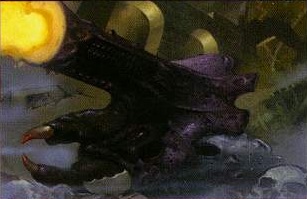
Tyranid Exocrine (Warhammer 40,000 collectible card game)

Armorcast Exocrine Warhammer 40,000-scale, (2nd Edition)[6]


See also
Sources
- 1: Chapter Approved 2001, pg. 103
- 2: White Dwarf January 2014 — Tyranids Exocrine
- 3: Games Workshop
- 4: Codex: Tyranids (6th Edition) (E-Book) — Forces of the Hive Mind
- 5: Magic: The Gathering's Universes Beyond Warhammer 40,000
- 6: Armorcast Warhammer 40,000 Model Archive(saved archive page, dated November 2001, last accessed 20 March 2025)