Space Marine Power Armour
| Energy Fields | Imperial Armour |
|---|---|
| Conversion field - Displacer field - Stasis field |

Space Marine Power Armour is a completely enclosed suit of armour, made of high grade composite ceramite[1] plating.[55d] The armour would be heavy and cumbersome to wear but for the electrically motivated fibre bundles within the armour that replicate the wearer's movement and enhance his strength.[1] Even though Power Armour incorporates gravitic energy dampers to reduce weight, it still weighs 250lbs.[65]
Contents
- 1 Overview
- 2 Components
- 3 Patterns
- 4 Other Designs
- 5 Additional Designs
- 6 Miniatures in Power Armour
- 7 Trivia
- 8 See also
- 9 Sources
Overview
Space Marine Power Armour is fully sealed, isolating the wearer from the outside environment and protecting him from gas weapons and harsh atmospheres.[60b] It is considered as having built-in void suit capabilities.[75] Should a penetration occur, resulting in a leak of the environmental seal and possible exposure to the vacuum of space, a quick application of repair cement is sufficient to restore its sealed environment (at least temporarily), though more advanced patterns such as artificer armour may have automated fibre re-weaving or similar systems.[60b] It also commonly includes numerous auxiliary systems such as communicators and auto-senses. The backpack contains the main power plant, environmental system and additional stabilizers.[1] The primary power source is a fusion generator which is capable of lasting forever with the proper care. This is important, as should a Space Marine's power armours motive system completely fail due to critical damage, the armour is very heavy and becomes a hindrance slowing the marine down making it difficult so much as to move around in unpowered armour.[60b] The backpack also houses a small Stacked Atomic Chain battery, powering the suit's life-support, air recycling, fluid recovery and various automated medical functions.[65] Still, should a marine require it, power packs also contain spare energy cells and a solar converter to recharge them.[61] All armour may further be augmented by various artefacts, relics and enhancements such as pauldrons and greaves.[1] The most important part of the armour scheme of Power Armour are its ceramite armour plates. These are individually up to an inch thick and are honeycombed to help dissipate energy and localise damage suffered.[65] Thanks to its ceramite and adamantium exterior, Power Armour is almost invisible to heat detection.[64]
Each individual suit of power armour has a unique history of battles it was worn in and are often comprised of the remnants taken from other suits having their own respective history. Due to this, the machine spirits of power armour tend to develop their own personalities over time.[60a]
Power armour has been in use since before the Age of the Imperium, from the techno-barbarians of Earth to the original Space Marines created by the Emperor. Over the history of the Imperium, power armour has developed into many different forms. Need, circumstances and recovery of new materials and technology has shaped the armour's evolution.[1][65]
Space Marine Power Armour

Space Marine Power Armour is an extraordinarily sophisticated defensive system which combines huge resistance to physical damage with a sensory array and sealed environment which protects its wearer from the ravages of the void and alien atmospheres. Integrated with the armour are networks of electro-motivated fibre bundles which mimic and augment the muscular strength of the wearer, so long as it remains powered.[2b][60b] The true genius of the design, however, lies in its close integration with the already superhuman physiology, senses and reflexes of the Space Marine within. Working in concert, armour and Astartes together become a weapon without equal.[2b] Space Marine Power Armour can withstand las-fire, bolt rounds, even cannon shots, but is significantly weaker at resisting power swords, which can cut through it with ease.[59] Power Amour reduces the damage taken from small arms somewhere between 50 to 85 percent, even offering at least some protection against all but the most devastating weapons deployed on the battlefield.[65]
Each suit of Space Marine Power Armour is a work of supreme artisanship, and although it may be one of many, each is a unique artefact whose spirit and history is of deep spiritual significance to both the Chapter to which it belongs and the Space Marine who wears it.[2b] It can take decades to complete just one suit of the new Mk VII power armour, so it is often easier to make spare parts for an existing suit than it is to make a completely new one.[5]
There are numerous different Marks of Power Armour, most of which date back in terms of design and application many thousands of years ago to the time of the Great Crusade and the Horus Heresy. Each has its own lore and genesis in place and time. Even in the 41st Millennium some intact suits from this near-mythical age survive in active service as war-relics of the Space Marines. Countless others have been produced or reacquired since, and different Chapters often have entirely different panoplies they can call upon to armour their forces. It is also far from uncommon for more recently fashioned armour to incorporate slivers or whole components from far older suits as revered connections to the past.[2b]
Space Marines go through an arduous process where they receive various implants culminating with the implantation of the Black Carapace, which allows the Marine a direct and instinctual interface with the armour, making it in effect a second skin. This grants the feeling of both touch and temperature to the wearer even while armoured, allowed by internal sensors that pass on these sensations through the Black Carapace.[72] The advanced systems of Space Marine power armour also monitor the Marine's biological functions and suit integrity, feeding the medical information to the Marine and alerting him to critical failures within his armour. A vox-datalink is also present, which allows for information, such as geo-locational data, to be relayed to an Astartes.[63]
Components
While Space Marine Armour has evolved and changed over the millennia, key components remain the same.[15]
- Backpack Power Unit: This houses the primary fusion power core for the armour, as well as reserve cells and an emergency solar collector.[15]
- Helmet
- Auto-senses: Contained in the helmet, these systems include thought-activated communication arrays, audio filters, targeting reticles, range finders, tactical displays, auspex-links, and a host of other features.[15] Auto-senses can react to perceived threats and automatically direct the wearer’s movements or the aim of their weapons.[73] Auto-senses also allow the Space Marine to hear a wider range of sound frequencies, while deafening noises are automatically dampened. They also allow for selective enhancement of a specific sound or image.[65]
- Photolenses: Protect the Space Marine from light bursts and allow him to see in the infrared and ultraviolet spectra, as well as enabling vision in low-light conditions.[15]
- Vox Link: Standard vox and channels for other data transmissions. The bio-monitor cogitator's feed transmits through this link, allowing squad members to view each others' vitals.[60a]
- Osmotic Gill Life Sustainer: While the helmet is attached, the armour is environmentally sealed and can maintain its oxygen supply as long as the unit is powered.[60a]
- Respirator Vox Grill: This thought-activated device amplifies a Marine's battle cry to deafening volumes and contains a respirator to filter out toxins and draw upon an internal oxygen supply.[15]
- Auto-senses: Contained in the helmet, these systems include thought-activated communication arrays, audio filters, targeting reticles, range finders, tactical displays, auspex-links, and a host of other features.[15] Auto-senses can react to perceived threats and automatically direct the wearer’s movements or the aim of their weapons.[73] Auto-senses also allow the Space Marine to hear a wider range of sound frequencies, while deafening noises are automatically dampened. They also allow for selective enhancement of a specific sound or image.[65]
- Life Signs Monitor: Bio-monitor cogitator and injection system of pain suppressors, combat stimms, and anti-toxins.[60a] Regulates a suite of life support functions, including an injection system that can regulate painkillers, anti-toxins, and combat stimulants.[15]
- Nutrient Reservoir: Body waste purification, reconstitution, and recycling system that intravenously returns nutrients to the body. Can sustain a Space Marine for long periods of time, but not indefinitely.[60a] A self-replenishing high-energy food store that can sustain a space marine's metabolism. Thus, during battle, there is no need for a space marine to eat or drink.[15]
- Protective shell
- Auto-Responsive Shoulder Plates: Shaped to deflect and absorb incoming blows, they usually display heraldry including chapter, company, and squad symbols.[15]
- Chestpiece: Designed to protect armoured power cables.[15]
- Reinforced Greaves: These incorporate gyroscopic stabilizers and power units that can magnetize the soles of the armour's boots, allowing Space Marines to walk on metal surfaces in the void of space or zero gravity environments.[15]
Patterns
Mark I "Thunder Armour"

Mark I plate was developed by the techno-barbarian factions that dominated Terra prior to the Emperor's ascendancy. When the Emperor began his conquest of Earth, the "Thunder Warriors", the proto-Space Marines which formed part of his retinue, were armoured in the same way as the soldiers of the other warlords. A thunderbolt and lightning symbol was displayed on the breastplate of warriors loyal to the Emperor - this was the personal badge of the Emperor in those days, predating the Imperial Aquila which only became the symbol of the Imperium much later. The emblem gives the suit its common name – "Thunder Armour."[1]
Thunder Armour was not an enclosing suit and offered no life support functions, being unnecessary while the fighting was confined to Terra and the similar environments of Luna and Mars. This early armour was produced on a completely local basis and as such individual suits varied heavily and their exact designs were often a matter of personal taste.[1]
The main part of the armour is the massive powered torso which encloses the chest and arms. Coiled energy cables beneath the armour plating transmit power from the power pack on the back to the arms, greatly increasing physical strength by a factor of between 3 and 4 times. Since fighting on Terra during this period was primarily close-quarters, the strength of a warrior's chest and arms was of paramount importance. The legs of this armour Mark are typically not power-armoured at all, but are enclosed in tough padded breeches. The best-equipped warriors sometimes wore armoured greaves and armoured boots, and such additional protection was common amongst the Thunder Warriors.[1]
As with all powered armour, the power supply is contained with a notably bulky back-mounted unit, most of which is taken up by cooling systems designed to prevent the entire armour design from overheating.[1]
Although it is very rarely used in the 41st Millennium, some suits of Thunder Armour are maintained for ceremonial purposes.[1]
This ancient style of armour is noticeably noisier than later Marks. [22]
Imperial Pattern

A class of power armour referenced in but a handful of sources, "Imperial Pattern" power armour is described as a highly idiosyncratic design notable for a helmet not unlike that of the much later Mark VI, for a distinctly archaic arrangement of vents and joints, and for lacking the flared grieves so distinctive of the known classes. In these sources, the wearers of this class also bear a singular weapon thought to be related to the almost obsolete volkite, some manner of disintegration beamer.[26] It was used by at least some Prototype Legionaires.[66] It was made available between Mark II and Mark III.[3b]
Mark II "Crusade Armour"

After the conquest of the main planets of the Sol system, the factories on Mars were set to work constructing a new type of armour for the Emperor's elite Space Marines. The first armour based upon recovered STC information[67], this armoured suit is commonly referred to as "Crusade Armour," since it was designed with the planned Great Crusade in mind. Its production led to the Thunder Armour being retroactively designated as the Mark I and quickly retired.[67] It was the first fully enclosed power armour, with life-sustaining capabilities[1], making it suitable for combat on toxic alien planets and the depths of space.[22] The first suit to interface with the Black Carapace which allowed for maximum synchronization[67], the Mk.II Pattern was standard for the Legiones Astartes during most of the Great Crusade, with millions produced[67], and its helmet in particular became a symbol for the Legiones Astartes throughout the Imperium. By the ending stages of the Crusade, Mk.II Armour had been phased out for the Mk.IV but many Legions still possessed them in great numbers. In particular, Legions not favoured by Warmaster Horus or had many units spread out on the frontiers of the Imperium retained the largest amounts of Mk.II Armour.[3a] Some Space Marines simply favoured the Mk.II over the Mk.IV for its reliability and history of service.[67]
Crusade Armour is fully plated, and the legs are also power armoured. The plates are arranged into articulated hoops, for increased manoeuvrability. The chest coils, which were kept on the outside of the armour plating on Mark I armour for cooling purposes, have now been placed on the inside of the chest plates, so that they are better protected, thanks to more efficient cooling mechanisms. However, this design could not be copied over to the new powered leg armour, which resulted in exposed cabling on the backs of the lower legs. The backpack is roughly the same size as that on the Mark I armour, but is much more efficient, and also includes extra life support, air recycling and fluid recovery equipment, as well as automated medical devices that have remained a part of Space Marine armour ever since.[1]
The helmet is fitted with automatic sensory devices developed on Mars, which allow the wearer to see and hear as though not wearing a helmet,[1] and, since all information is transmitted to a computer in the helmet before being transmitted directly to the wearer's brain via neural link, it enhances sight and hearing while dampening blinding lights and deafening noises.[22] The wearer is also able to see in the infra-red and ultra-violet spectrums, images can be zoomed in and magnified while noises can be enhanced.[1]
Mark II armour is believed by many to still be the most efficient example of power armour design, although with the caveat that the overlapping hooped armour plates are difficult to repair. It can still be found in operational use - in extremely limited numbers - amongst several Space Marine Chapters.[1]
Mark II armour had several subtypes, such as the Paravane sub-subtype used by the Dark Angels, an idiosyncratic variant of the widely issued Mark II pattern produced by the artificers of the 1st Legion, which was renowned for its exceptional void endurance and enhanced systems.[36e][55a]
- Pictures of MKII Variants

Dark Angels Mk II Armour (Paravane sub-type) [55a]

Emperor's Children Mk II Armour with Phoenician-pattern helm[54g]

Space Wolves Consul-Opsequiari with Mk II variant helm[24b]

Pre-Magnus Thousand Sons Mk II Armour with Stygian-pattern helm[54c]

Thousand Sons Mk II Armour Achaean Sub-pattern variant[24a]

Iron Warriors Mk II Armour with Decimator sub-pattern helm[54a]

Death Guard in Mk II Armour modified with enhanced breathing apparatus.[4c]

White Scars Mk II Armour with Qayan-Pattern helm[55b]

World Eater Mk II Armour with Sarum-pattern helm.[54b]


Mark III "Iron Armour"

This model dates from the wars of the Great Crusade, when Astartes Legions were forced into deadly boarding actions and tunnel combat.[Conflicting sources] This armour was ideal when cover was minimal and combat was a matter of frontal assault.[1] The most visually brutal and imposing of all the widely produced armour marks, the Iron Armour was a heavy, modified Mark II design (itself the first mass-produced Power Armour of the Crusade era). The Iron Armour's structure has augmented frontal defence and incorporates additional ablative plates, and is intended foremost for use in boarding actions, tunnel assaults and void warfare, although it is considerably heavier and more power hungry than its contemporaries.[2b] The new helmet design is a heavily armoured model with sloping plates designed to deflect shots to the left and right, and inspired the Mark IV and VI helmet designs.[1]
Mark III was never intended to replace the previous Mark but to act as an optional suit specialised for situations where heavier frontal protection would be advantageous, such as in the close confines of spacecraft and mining complexes.[22] Because of this, no Legion was ever fully equipped with the Mark III. While successful in the conditions it was designed for, the armour is too clumsy and uncomfortable for conventional fighting. Nonetheless it became widespread in some Legions, such as the Imperial Fists and Death Guard. Meanwhile the Dark Angels and Space Wolves also favoured the design, perhaps due to its more bellicose nature.[3a]
The Mk.III is sometimes worn by ceremonial guards due to its visual brutality, and can also still be found used in close-quarters situations by various Space Marine Chapters. It is commonly called the Iron Suit or Armorum Ferrum in recognition of its great strength.[1]
Today, Mk.III Crusader-Pattern helms are still standard in the Terminator Armour of the Grey Knights due to their superior protective properties.[71]
- Pictures of MKIII Variants

Death Guard' Sollan Gath wearing a modified Mark III Armour[35]

World Eater with a modified Mark III helm[4b]

Blackshields Legionary Kell Dray[38]


Imperial Fists Templar Brethren variant Mark III Crusade-pattern helm[55f]

Iron Hands Mark III helm[55g]

Iron Hands Artificier-modified Mark III helm[55g]

Death Guard variant Mark III Korpus-Pattern helm[54b]

Salamander Artificier-modified Mark III helm variant[55h]


Mark IV "Maximus Armour"

At the end of the Great Crusade the Space Marines found their armour wearing out. While some Legions chose to continue local production and maintenance, the Mechanicum of Mars started to design a new variant for centralised issue, which was to be designated the Mark IV or Imperial Maximus suit.[1]
At the Mark IV stage of the power armour development, Space Marine armour began to take on an appearance recognisable as contemporary power armour, the main change being the abandonment of the separate abutting plates in favour of larger, inflexible armour casings incorporating flexible joints. This marginally reduced mobility but was far easier to produce and maintain.[1]
Technical secrets recovered on newly conquered worlds allowed Mars to develop the more efficient armour, improving the quality of protection and reducing the suit's weight at the same time. Improved armouring of the power cables allowed the main arm and chest supply to be safely relocated to the exterior of the armour, while the use of new material reduced the size and number of cables.[1] Among these features was a Suspensor layer introduced inside the armour, which protected the wearer from the effects of immense pressure and gravitational forces, sharing basic functionality with the suspensor-wire pressure flight suits worn by starfighter pilots.[73]
The helmet was a completely new design, the basic shape inspired by the sweeping front of the Mark III. In Mark IV and later versions the helmet is no longer fixed, but moves with the wearer's head. This represented the constructors' increasing experience with neural connector gear and the new materials which flooded into the Martian workshops as the Crusade progressed.[1]
Mark IV armour was envisioned at the time to be the ultimate and final type of Space Marine armour, able to offer the best protection in a variety of conditions. Many of the Space Marine Legions were entirely or partially re-equipped with it, although the order of which Legions received the armour would shortly prove to be of significance.[1] As a result of its widespread production and use prior to and during the Horus Heresy, Mark IV suits are the most common of the pre-Heresy armour Marks still in service during the 41st Millennium. The Pattern was initially most widespread in Legions that were favoured by Warmaster Horus, and thus would become synonymous with Traitor Astartes.[3a] Notably, a few Chapters, such as the Red Scorpions and Iron Hands, are still capable of producing new Mark IV suits in the 41st millennium.[2b]
The round nozzles on either side of the backpack are not only for heat dissipation but also could be used as stabiliser jets in zero gravity conditions.[13]
There were many variants of Mk.IV armour produced, such as the Praetor Pattern used by the Ultramarines at Veridia Forge at the time of the Great Crusade.[11]
- Pictures of MKIV Variants

Mark IV helm variant used for Destroyer Marines[68]

Achean Pattern design of the Thousand Sons, produced by the forges of Prospero[3c]

Cadaere Renissum Pattern - World Eaters[54b]

Seeker Pattern - used by the Headhunters of the Alpha Legion.[54e]

Dark Angels Deathwing Companion in Mark IV Armour with Deathwing Variant Helm[55a]

Blood Angels Hanael-Pattern Mark IV Variant Helm[55c]

Blood Angels Kepharel-Pattern Mark IV Variant Helm[55c]

Ultramarines Praetor-Pattern Armour[57]


Iron Warriors Mk.IV helm variant[54h]

Night Lords Mk.IV Helm variant[54i]

Praetor-Pattern Helmet worn by Ultramarines' Veterans[39a]

Cthonian variant helmet worn by Sons of Horus legionaries[54d]

Sons of Horus variant Mk.IV Helm used by veterans and elite[54d]

Thousand Sons Achean Pattern variant helm[54c]

Thousand Sons Achean Pattern Apothecary variant helm[54c]
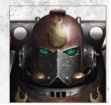
Word Bearers Mk.IV helm variant[54k]
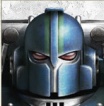
Alpha Legion Mk.IV helm variant[54f]

Alpha Legion Aspektas-pattern variant helm[69][70]


Mark V "Heresy Armour"

The equipping of the legions was only partially complete when the Horus Heresy broke out. Many of the Legions that had just been fully equipped with Mark IV armour turned against the Imperium while many of the loyal Legions had been deliberately starved of access to it and remained operating with the older Mark II and Mark III armour. Additionally, even the Legions equipped with Mark IV suits quickly found themselves low on spare parts and unable to manufacture replacement units. With war damage and mobile operations, resupply for damaged equipment was difficult or impossible. Marine artificers and Techmarines had to use old style equipment from older models to keep the legions fighting, as well as salvage from slain enemies and unorthodox innovations of their own.[1][22]
This ad-hoc assemblage of various armour mark segments (including new or unofficial design elements) being created by a multitude of legions resulted in an entirely new mark of armour being 'accidentally' created; these previously non-standard, emergency/stopgap designs were retroactively termed as the Mark V once production of the Mark IV was halted and the design for the subsequent Corvus Armour mark (Mark VI) was finalised. Some form of standardisation across Mark V suits is notable, despite their apparently random creation and individual varied origins, due to the dissemination of molecular bonding techniques across the legions. These techniques were developed due to battlefield experience in fighting other Astartes; Astartes plate needed to be proof against their own penetrator weapons, and it was discovered that power armour would benefit from additional reinforcing in this regard.[21] All sorts of improvised additional armour can be seen on Mark V suits, but the most common technique was affix additional layers of armour with the aforementioned molecular bonding studs. This relatively quick and simple technique effectively added another ablative layer to marine armour suits. The extra weight this generated would prove considerable, however, which placed a strain on power supplies. As the addition of extra power generation sources and cabling would just require more armour plating, catching the design in an eternal circle, the wearers of the suit was forced to either deal with the additional weight, or turn up the power output of his backpack but suffer extreme heat output, which not only would prove uncomfortable and even compromising in certain situations,[1][22] and in many cases older, heavy power cabling was used, which created a weak point on the chest[22]
Many Mark V suits ended up featuring an unusual helmet design appropriated from supplies generated by the Tactical Dreadnought Armour program; this spin-off helmet featured similar levels of improved auto-senses as Terminator suits, but was still found to be inferior to those of Mark IV suits.[1] The respirator used for this helmet was codified as the Mantilla-pattern, and saw use as early as late M30.[4a]
The Mark V would be the most common armour mark visible during the Horus Heresy, by its nature as a mark resulting directly from the concerns of that galactic civil war. As a result, the Mark V is commonly called the Heresy Suit and is distinguished by the molecular bonding studs often seen on areas such as the helmet, shoulder plates and greaves. Few Imperial Space Marines are ever seen in Mark V suits today, as the loyalist Chapters either broke up these suits for spares or purposefully destroyed them after the Heresy was over. In contrast, many Chaos Space Marines still wear Mark V armour by default[1], either because they still possess their original suits or because they are forced to scavenge equipment. The Mk.V became most prevalent in the Shattered Legions due to their more desperate situation.[3a]
This power armour carries resonances of the Imperium’s darkest hour and its greatest victory. Battle-Brothers will offer the wearer their respect. However, members of the Inquisition are instinctively suspicious of any connection to the Horus Heresy.[22]
- Production Mark V
Production Mark V is the most widely recognisable form of Mark V, and consists of elements of power armour that most Legions were able to manufacture in their own forges, or otherwise obtain themselves, falling back on common designs for parts that had specific cross-compatibilities, often deriving from Mark IV, V, VI and later Mark VII.[26]

Gerasene Host Legionary[36d]

Alpha Legion Legionary[3e]


- Non-production Mark V
Non-production Mark V is a genuine amalgamation of field modifications combining several different marks of armour in ways no Tech-Priest would ever think to sanction. In general, Mark II and III components can be combined without issue, as can those of Marks IV, VI and the much later Mark VII. Parts outside these two distinct groups can only be combined with one another with great difficulty, however, and so this was often only seen in the more technically adept Legions such as the Iron Hands and Salamanders - in particular those elements of the Shattered Legions that were cut off from ready sources of resupply in the wake of the treachery at Istvaan V.[26]

Dha'lok, Salamanders in non-production Mark V with Mark III helm[36a]

Blackshield Legionary in non-production Mark V with Mark VI helm[36b]


Mark VI "Corvus Armour"

At the end of the production of Mark IV armour, a long term research project began to replace it. As this remained a theoretical endeavour for some time, it lead to the production of the Corvus Suit as a stopgap measure, using a mixture of new and old features.[1] The Mk.VI has become infamous for its use amongst those associated with stealth and infiltration, such as the Raven Guard and Alpha Legion.[22]
The first Mark VI prototype design (which bore the provisional designation of Mk V at the time) was field-tested during the Great Crusade's Scalland Campaign by Legionaries of the Raven Guard, whose experiences and comments resulted in improved design features in the finalised armour mark. Prototype Mk.VI was already in circulation amongst many Legions by the time of the Heresy, but it proved controversial for some of these, with the Iron Warriors flatly rejecting the design entirely in favour of heavier armour.[67] Meanwhile, the Alpha Legion was able to acquire small numbers of prototype Mk.VI Armour and modified it according to their Legion's own needs. Built in secret, the "Corvus-Alpha" pattern of Corvus Armour first saw use openly during the Horus Heresy.[19] Production and mass issuing of the Mk.VI was interrupted by the outbreak of the Heresy and subsequent Schism of Mars, with many suits being evacuated off Mars as the world fell to Dark Mechanicum forces.[67]
The finalised armour mark was issued just as the Horus Heresy began.[67] It was named Corvus Armour in honour of Corvus Corax, Primarch of the Raven Guard, and the first sets of it shipped to the Raven Guard Legion ahead of all other loyalist legions, in recognition not only of their role in the design process, but of the sacrifices made by the Raven Guard in the Drop Site Massacre and their determination to rebuild and rejoin the fight against Horus the Great Betrayer.[21] By the time of the Siege of Terra the Mk.VI was the most widely issued variant in loyalist service, with entire chapters of the Blood Angels and Imperial Fists being equipped with the pattern.[67]
Meanwhile, as the war ground on, the Dark Mechanicum was able to hack the data vaults of those still loyal to the Emperor to provide the designs to Horus and his forces. With countless Forge Worlds under the control of the Warmaster, production of Mark VI armour continued apace for the Traitors, and the Emperor's Children in particular used it en masse during the Siege of Terra. The predominance of the Corvus armour would continue well into The Scouring and the present age.[26][28]
Mark VI armour offered no better protection-levels than the Mark IV, but incorporated more efficient internal systems where power-routing and auto-senses were concerned. Power systems were given back-up redundancies with no increase in weight, while both olfactory and auditory sensors were improved. Additionally, the armour featured the best stealth capabilities of all power armour marks so far designed[21], as well as a new method of compartmentalising components that allowed them to be swapped out with pieces from previous marks with ease.[1] It is the lightest variant of power armour and featured dual technology circuits that allowed the replacement of rare or sophisticated parts with common or basic alternatives. It also included fail-safes such as duplicate power cabling.[22]
Corvus Armour is also distinctive for its conical nose – designed to house additional systems including advanced auto-senses. According to some, the studded left shoulder pad, taken from the previous MkV pattern, commemorates the glory of those heroes who stood at the Eternity Gate alongside the Emperor himself.[17] Others said that studded shoulder pads shows the parts where additional ceramite armour was bonded to the armour - due to the need for quick field repairs.[18]
The Mark VI features clean, sleek lines, due to the routing of power cables under the exterior armour plate (abdominal covering of these was one of the suggestions made by the Raven Guard) and the increased sloping of the helmet design. The left shoulder armour features the tell-tale molecular bonding studs of Mark V armour. The initial suits did indeed use the ablative technique pioneered in Mark V suits, as paucity of supplies during the Heresy meant that some sacrifices still had to be made, even with a new armour design. In later years, the left shoulder was armoured to the same level as the right, but the studs were still affixed in a deliberate continuation of the honoured design that had won the Horus Heresy for the Imperials.[1]
Most such sets of battleplate in Dark Angels hands had been part of the original prototype shipments, and many had seen either extensive battlefield modification or featured experimental gear not present on later production issue MkVI battle plate. Indeed, many of these modifications would be replicated on standard issue MkVI armour captured from the Night Lords or acquired from Compliant Forge Worlds during the long years of the Thramas Crusade.[62]
Chaos Space Marines can be seen in this armour despite its association with Imperial Space Marines; they captured a significant quantity of the suits on Mars during the Heresy, as well as Mechanicum production facilities, and were therefore able to produce their own Mark VI suits.[1]
- Pictures of MKVI Variants

Dark Angels Firewing warrior in Mark VI with enhanced auto-senses[62]

Sons of Horus with Cthonian Pattern "aggressor" helmet[37]

Alpha Legion Mark VI "Corvus-Alpha" variant[54e]

Space Wolves Mark VI helmet variant[29]


Mark VII "Aquila Armour"

Mark VII armour, also known as the “Aquila,” “Imperator”, “Eagle” armour[1] or “Armorum Impetor”[25], was developed during the Horus Heresy by loyalist Fabricator-Locum Zagreus Kane[58], and remained in use as one of the most common form of power armour ten thousand years later. It represents the final major development of Mark VI armour.[1]
While the final battle for Mars was underway, the Imperium realised the planet would eventually be lost. Armour development teams were transferred to Earth to continue, incorporating their latest work into the armour type that would become Mark VII. As Mars fell to Horus, the new armour began reaching the Space Marines on Terra and Luna.[1] The Mk.VII was first issued in large numbers to the loyalist Legions during the Great Scouring.[67]
Mark VII's main improvement is the newly designed chest plastron which covers the chest and arm cabling. The chest bears the Imperial Eagle, giving the armour its common name of Armorum Imperator, or Eagle Armour. This mark abandons the studded shoulder armour plate, and replaces the helmet. As Mark VII is a development of Mark VI, both have a great deal in common, and parts from one mark are readily interchangeable with parts from the other,[1] like the helmet.[22]
Mark VII contains its own back-up power supply and a solar array to recharge this, so the suit can operate even without its backpack though only a short time.[25]
Curadh pattern Power Armour
Company Champions wear armours specifically crafted for them. This pattern of armour is known informally as the Curadh variant and is based loosely on Aquila-pattern battleplate. It features additional reinforcement upon the shoulder guards, designed to showcase the Champion's many honours and provide better protection. It also comes with a reinforced breastplate emblazoned with a winged shield, where a Champion is allowed to display his personal heraldry. As for the helm it is deliberately fashioned to resemble knightly helms of Terra's ancient past.[32] This armour pattern was also available to Sergeant Revok of the Fire Angels Chapter.[33]

Curadh pattern on a Company Champion[6c]

Curadh pattern on Sergeant Revok of the Fire Angels[33]


Mark VIII "Errant Armour"

The suit itself is a highly modified Mark VII, with additional fixed armour plates on the torso that now enclose all of the suit's cables, which were vulnerable to weapons fire, a new armoured collar protects the helmet's respirator, and also addressed the vulnerability issues of the neck joint, which had been known to act as a "shell-trap", (a round could hit the chest armour and be deflected up into the neck joint)[22], and augmented poldron armoured sections.[2] The new collar required a new helmet design, which caused problems for backward compatibility with earlier helmet types.[22]
Mark VIII armour has only seen limited production thus far, and is seen in limited numbers on the battlefields of the 41st millennium. Often, it is worn by Veteran Space Marines as a symbol of rank[22], and is commonly found amongst the ranks of the Deathwatch[31], and the Minotaurs.[34]

MKVIII Ultramarine[56]

MKVIII Armour on a Deathwatch marine[31]

MKVIII Armour on Veteran Sergeant Courras[30]


Mark X "Tacticus" Armour

Mark X Tacticus armour is a suit that combines the most effective elements of ancestral Horus Heresy patterns of plate with more recent developments in power armour technology. The Mk.X was developed by Magos Belisarius Cawl at the same time as the Primaris Marines. These suits are currently carried into battle by Primaris Space Marines during the unfolding Indomitus Crusade.[7]
The Mk.X is a design more versatile than its predecessors. There is no single appellation and design but instead a modular system of ceramite plating that can be adjusted for a multitude of tactical roles, from the scouting and reconnaissance capabilities of Phobos pattern all the way up to the heavy Gravis pattern worn by Aggressor Squads.[7]
The Mk.X also allows for the utilization of a new breed of weaponry, such as Bolt Rifles, Assault Bolters, Heavy Bolt Rifles, Boltstorm Gauntlets, Auto Bolt Rifles, Melta Rifles[7], and Plasma Incinerators.[7]

Mk X Gravis Pattern

The Mk.X has several different variants, such as the Mk.X "Gravis" heavy armour used by some captains and apothecaries, Heavy Intercessor Squads, Aggressor Squads,[7] Eradicator Squads,[10] and the jump pack-capable variant used by Inceptor Squads. The Gravis pattern of Mk.X Armour is more heavily protected and allows for a level of protection akin to that afforded by a space marine bike, but with reduced mobility comparable to Terminator Armour.[7]
Mk X Phobos Pattern

Another variant of the Mk.X is the Mk.X Reiver or Phobos pattern. The suit’s lighter-weight ceramite and streamlined design allow for greater mobility, and its servo-motors are engineered to be completely silent. As the name suggests, it is used by Vanguard Space Marine squads, including reiver squads.[8]
Mk X Omnis Pattern

A lighter jump pack- and grav chute-equipped blend of the Gravis and Phobos patterns, known as the Omnis-Pattern, is utilised by Vanguard Suppressor Squads.[9]
Other Designs
Runic Armour
The Space Wolves grant valiant members of their chapter specially crafted suits of power armour inscribed with runes of protection by the Rune Priests. These provide the wearer with a defence against psychic attacks. This armour is created by the Iron Priests, and at least some examples are known to be codified as the Mark XII Lupio pattern.[14]
Aegis Armour
Grey Knights wear Aegis Armour, power armour that is incredibly well crafted; anointed and inscribed with prayers and wards, ritually consecrated and psychically charged. The suits are generally based on components from Mark VI, VII and VIII power armour designs, with a modified helmet design with a tapered, knight-like visor.[74]
Terminator Armour
Like power armour, Terminator suits have an outer shell of ceramite-bonded plates powered by electrically-motivated fibre bundles. Plates of heavy plasteel further armour the ceramite sections, especially on the front of the suit. This extra armouring provides a level of protection that is far superior to normal Marine armour; not even a Krak missile will penetrate the suit's breastplate.[23]
Additional Designs
A number of variant components for Space Marine power armour are known to exist. Although designs and components are subject to variation, especially in the case of Artificer Armour, more standardized spin-off designs have been developed over the course of the Imperium's history. These include the Sarum and Phoenician pattern helmets (the latter of which was exclusively used by the Emperor's Children)[4a], and the Praetor pattern power armour, which was locally produced at Veridia Forge by the Ultramarines in the later years of the Great Crusade.[11]
In addition, a number of Space Marine backpack units have been identified. Although the M.35, M.36, and M.37 designs are usually used by Imperial Space Marines in the 41st Millennium [12], a number of designs associated with older Marks of power armour, such as the Mars[4a] and Phaeton[16] pattern backpack units, are still used to some extent. Additionally, the Anvilus pattern backpack is a Crusade-era Imperial prototype that incorporated advanced thruster vents for use in void operations, but at the cost of decreased radiation shielding.[4a]
Miniatures in Power Armour
Trivia
 |
- The Mk X Phobos-pattern armour first appeared on Reivers. Due to their nature as terror troops, the armour's name likely references Phobos, the Greek god of fear.
Conflicting sources
- The MkII armour is claimed in Deathwatch: Rites of Battle to not be able to move its helmet, with the Astartes still being able to rotate his head around inside said helmet. This conflicts with Forge World's depictions of the MkII armour set and the novel Horus Rising, where an Astartes is seen in MKII Power Armour with the helmet turned toward several of his brethren.[26] According to Games Workshop, Forge World intentionally redesigned the armour's helmet and neck joint in this way to enable more modelling options.[13]
Squat Influences
- The Squats' influence on the development of MkIII armour conflicts across sources and time. White Dwarf 128 (1990) places MkIII development firmly because of the squat homeworlds in the galactic core. By the time of the Deathwatch RPG, the Rites of Battle supplement (2011, a second-party supplement) references the following:
"A new variant of power armour was created during the Emperor's wars with the inhabitants of the worlds close to the galactic core. These high-gravity planets were home to an extensive industrial civilization that put up stiff resistance to the Imperial Crusade."[22] Squats are specifically not mentioned, and this was released before the re-launch of the Horus Heresy tabletop game. By the time a webpost was written about it on Warhammer Community (most recently accessed 2021, but posted earlier), that has been solidified as being created for boarding actions and tunnel fighting, with no reference at all to the galactic core or high gravity worlds.[13]
See also
Sources
- 1: White Dwarf 129 (UK), pgs. 13-18 — Space Marine Armour
- 2: Imperial Armour Volume Ten - The Badab War - Part Two
- 3: Horus Heresy: Age Of Darkness 2nd Edition Rulebook:
- 4: The Horus Heresy Book One - Betrayal
- 5: White Dwarf 72 (2015) — Focus On... Armour of the Ages
- 6: How to Paint Space Marines:
- 7: White Dwarf June 2017, pgs. 44-45
- 8: Codex: Space Marines (8th Edition), pg. 71
- 9: Codex: Vanguard Space Marines (8th Edition), pg. 7
- 10: Codex: Space Marines (9th Edition), pg. 175
- 11: Know No Fear (Novel), Target//Acquisition, pg. 20
- 12: White Dwarf 249 (UK), pgs. 30-33 — Emperor's Shield: Space Marine Chapters of the Armageddon War
- 13: Warhammer Community - Power Armour Through the Ages (last accessed 8/15/2021)
- 14: Codex: Space Wolves (5th Edition), pg. 61
- 15: Codex: Space Marines (6th Edition) (E-Book Edition), pg. 29
- 16: The Horus Heresy Book Two - Massacre, pg. 17
- 17: Forge World (last accessed 24 January 2016)
- 18: White Dwarf 128 (2016), pg. 19 — Legion Veteran Tactical Squad Osirio
- 19: The Horus Heresy Book Three - Extermination
- 21: Deliverance Lost (Novel), pgs. 328-30
- 22: Deathwatch: Rites of Battle, pgs. 149-152
- 23: Wolf's Honour (Novel) – Space Wolf: The Second Omnibus, Chapter One, pg. 519
- 24: The Horus Heresy Book Seven - Inferno
- 25: Imperial Armour Volume Three - The Taros Campaign, pg. 48
- 26: Leman Russ: The Great Wolf (Novel), Chapter II
- 28: Warhammer Community (17/05/2022) (last accessed 19/5/2022)
- 29: Warhammer Community: Heresy Thursday – New Treats for Well-Behaved Space Wolves (posted 4/8/2022) (last accessed 4/8/2022)
- 30: Codex: Space Marines (6th Edition), pg. 69
- 31: Codex: Deathwatch (7th Edition), pg. 10-11
- 32: Index Astartes: Company Champions (Background Book), pgs. 13-15
- 33: Imperial Armour Volume Nine - The Badab War - Part One, pg. 94
- 34: Imperial Armour Volume Twelve - The Fall of Orpheus, pg. 140
- 35: The Horus Heresy Book Four pg.155
- 36: The Horus Heresy Book Six
- 37: Campaigns of the Age of Darkness: The Siege of Cthonia, pg. 118
- 38: Campaigns of the Age of Darkness: The Battle of Beta-Garmon, pg. 85
- 39: The Horus Heresy Book Five - Tempest
- 54: Liber Hereticus (2nd Edition):
- 55: Liber Astartes (2nd Edition):
- 56: Codex: Space Marines (5th Edition), pg. 20
- 57: Horus Heresy: Collected Visions, pg. 158
- 58: Campaigns of the Age of Darkness: The Martian Civil War, pg. 17
- 59: Traitor General (Novel) — The Lost (Omnibus), Chapter Twenty
- 60: Deathwatch Core Rulebook:
- 61: Warhammer 40,000: Rogue Trader pg 115 Armour Profiles
- 62: The Horus Heresy Book Nine pg.148
- 63: Secret Level episode 5, Warhammer 40,000: And They Shall Know No Fear
- 64: Blood Gorgons (Novel), Chapter Five
- 65: Codex: Angels of Death (2nd Edition), pg. 8
- 66: Saturnine (Novel), Part 2 - Chapter 3
- 67: Horus Heresy: Age of Darkness 3rd Edition Rulebook, pg. 37-41
- 68: Exemplary Battles of the Age of Darkness: Volume One, pg. 65-67
- 69: Liber Hereticus (3rd Edition), pg. 305
- 70: Games Workshop Alpha Legion Mk.IV Upgrades saved page, original link: https://www.warhammer.com/en-US/shop/alpha-legion-mk6-heads-2023?queryID=9357148e9df71c90c8424485817c1484 (last accessed 6/8/2025)
- 71: Codex: Grey Knights (10th Edition), pg. 24
- 72: Lazarus: Enmity's Edge (Novel) Chapter 5
- 73: Prince of Crows (Novella), Chapter 9
- 74: Codex: Grey Knights (5th Edition), pg. 8
- 75: Wrath & Glory Core Rulebook (2nd Edition) pg.234